Did CPG companies siphon money from consumers to shareholders?

The claim going around: record profits from price hikes, handed straight to shareholders through buybacks. I ran the numbers on 100 US CPG companies. Shareholders did get paid more — but future investment grew faster.

By Alex KhmuretsPublished September 21, 2026Data SEC XBRL, 10-K cash-flow statements

Where the cash went, FY2023–25

Twenty largest US CPG companies by revenue. Every bar is three years of cash out the door: dividends and buybacks in red, factories (capex) in black, labs (R&D) in gray.
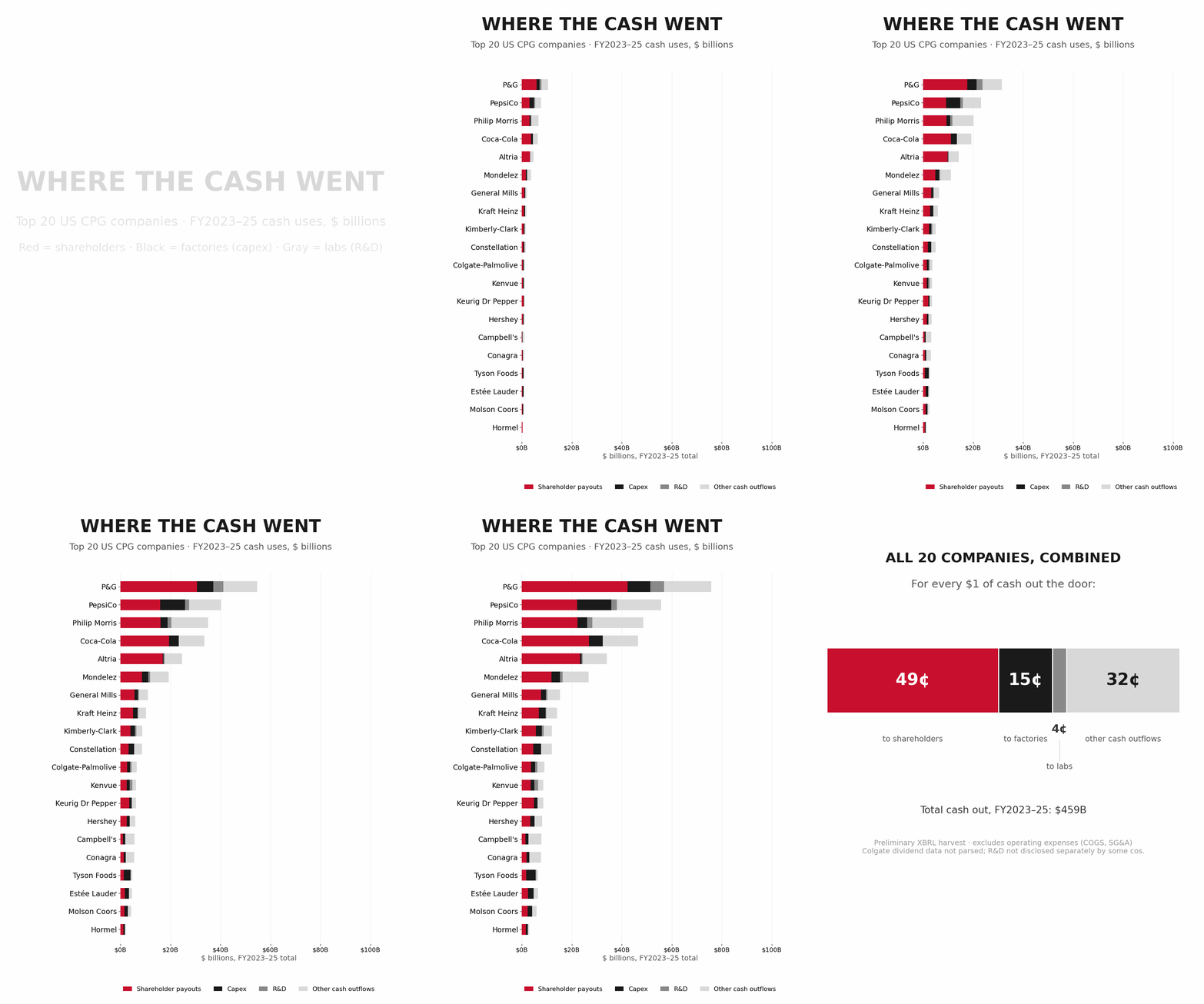
Animated chart: FY2023-25 cash uses for the top 20 US CPG companies, then the combined split — 49 cents of every dollar to shareholders, 15 cents to factories, 4 cents to labs, 32 cents to other cash outflows.
Preliminary XBRL harvest. Excludes operating expenses (COGS, SG&A). Colgate dividend data did not parse; some companies do not disclose R&D separately.

The takeaway the chart hands you: for every $1 of cash out the door, 49¢ went to shareholders, 15¢ to factories, 4¢ to labs — and 32¢ to everything else (acquisitions, debt repayment, taxes, interest).

Investment grew faster than payouts

Comparing FY2020–22 against FY2023–25 across 100 US CPG companies:

+21%
Capex
$74.9B → $91.0B
+19%
R&D
$19.8B → $23.5B
+14%
Dividends + buybacks
$219.7B → $251.2B
69.9¢ → 68.7¢
Shareholder share
of every $1 to payouts or investment

The longer view says the same. On 41 companies with matched data back to FY2017–19 (pre-COVID) versus FY2023–25: capex +25.6%, R&D +23.3%, payouts +21.5% — and the shareholder share of the dollar fell from 70.7¢ to 70.0¢.

Precision worth keeping: dividends alone grew 18%, nearly matching capex — it is buybacks that stalled (+6.5%). Acquisitions fell 39% at the top 20: build, don't buy.

Payouts grew slower than the business

Six of the top 20 with clean revenue data in both windows (PepsiCo, P&G, Tyson, Coca-Cola, Mondelez, Campbell’s):

+16%
Revenue
$834B → $969B
+5.5%
Dividends + buybacks
$112B → $118B
+14.5%
Capex + R&D
$44B → $51B
13.5% → 12.2%
Payout margin
payouts as share of revenue

Payouts are a shrinking share of revenue. Investment held steady at ~5% of revenue. Sub-panel: only 6 of 20 companies had consistent revenue tags in the XBRL pull — treat as directional, not final.

Executives say build, too

The filings show the money. The executives explain the intent — never from the same source as the numbers.

Nestlé’s first priority is RIG-led organic growth — real volume, not price
Stat: RIG = Real Internal Growth, Nestlé’s volume-and-mix growth measure
“We have consistently said that our first priority is investing to drive RIG-led organic growth, although we see room for selective bolt-on acquisitions where they accelerate growth, particularly supporting our growth platforms.”
— Anna Manz, CFO, Nestlé, FY2025 results call, February 19, 2026. Nestlé launched Vital Pursuit, a brand built for GLP-1 users.
Nature’s Bakery is building a new factory in Salt Lake City
Stat: capacity capex — relieving existing bakeries, funding 4–5 years of growth
“Our current bakeries are bursting at the seams… we’re building a new factory in Salt Lake City that will actually start producing sellable product just in this summer.”
— Steve Gardiner, CEO, Nature’s Bakery, CPG Guys podcast, February 20, 2025
Coca-Cola brought on a new fairlife plant after running out of capacity
Stat: capacity capex — fairlife was supply-constrained through 2025
“Supply chain constrained by running out of capacity in ’25. Now we’ve brought on a new plant and some new lines are coming in.”
— James Quincey, CEO, Coca-Cola, CNBC interview, January 20, 2026
Danone is training 20,000 factory workers in AI
Stat: Industry 5.0 Academy in Poland + a network of 10 pioneering smart factories
“The academy is just the beginning. Our ambition is to set new industry standards for human-machine collaboration, enhancing our service to customers worldwide.”
— Vikram Agarwal, COO, Danone, on the Industry 5.0 Academy

So while shareholders got their cut — and dividends kept pace with investment — the bigger story is that CPG spent the pricing windfall building: factories, labs, and AI. Not just distributing it.

The question I’d send to my team: if the next growth cycle comes from capacity and innovation instead of price, who’s actually built for it?